Michigan Property Tax Estimator 2026: $250K Home = $5,000
Updated September 2026 · 12 min read · By Munir Afridi
Figures verified against Michigan State Tax Commission Bulletin 14 of 2025 (Nov 18, 2025) for the 2026 inflation rate multiplier, MCL 211.27a and MCL 211.34d for valuation and uncapping, MCL 211.7cc for the principal residence exemption, MCL 205.735a for appeal jurisdiction, the Michigan Department of Treasury 2024 total property tax rates report for millage, and Treasury guidance on the Homestead Property Tax Credit.
Quick Answer
Michigan property tax is taxable value times the total millage, divided by 1,000. On a home you just bought for $250,000, taxable value resets to about $125,000 (half of market value), so at a typical 40-mill principal residence rate you owe roughly $5,000 a year, or $417 a month. A neighbor who has owned the identical house since 2015 pays closer to $3,691, because Proposal A capped their taxable value growth at just 2.7% for 2026 (inflation rate multiplier 1.027, Michigan State Tax Commission Bulletin 14 of 2025). Never budget from the seller's tax bill: it is not your bill.
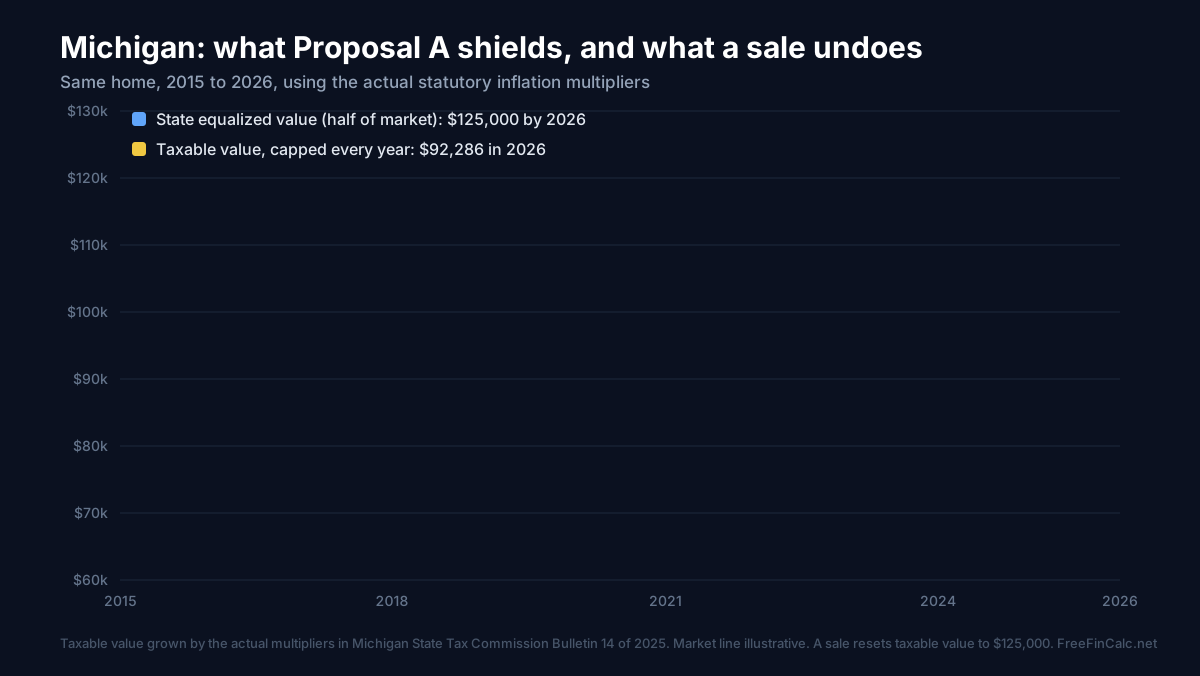
Michigan is one of the few states where two identical houses on the same street can carry property tax bills that differ by 35%, permanently, with nothing illegal or unusual going on. The reason is Proposal A, passed by voters in 1994, which separated what your house is worth from what you are taxed on and then capped how fast the second number can grow.
That design rewards staying put and punishes moving. It also means the tax figure in a listing, the one the seller has been paying, is close to worthless as a forecast of what you will pay. This guide gives you the formula, the 2026 numbers, real millage rates from the state's own rate report, and the four mistakes that cost Michigan homeowners the most money. To estimate your own bill as you read, open the Michigan property tax calculator.
How do I estimate my Michigan property tax?
One formula does all of it. Everything else in this article is about getting the right number into the first slot.
ANNUAL PROPERTY TAX = TAXABLE VALUE x TOTAL MILLAGE ------------------------------ 1,000 Example, home just purchased for $250,000 in a 40-mill principal residence community: Taxable value $125,000 Total millage 40.000 125,000 x 40 / 1,000 = $5,000 per year = $417 per month
A mill is one dollar of tax per thousand dollars of taxable value. Forty mills sounds abstract; it means 4% of taxable value, which because taxable value is roughly half of market value works out to about 2% of what the house is worth. That is why Michigan bills feel high next to states with lower headline rates.
The trap is the first line. Most people substitute their purchase price, or the Zillow estimate, or the assessed value from the notice. All three give the wrong answer, and one of them gives an answer that is double the truth. Run your own numbers in the Michigan property tax calculator while you read, or use the general property tax calculator to compare against another state.
What is the difference between assessed value and taxable value?
Your February assessment notice lists at least three numbers, and they are not interchangeable. Getting them straight is most of the work.
| Number on your notice | What it means | Used for your bill? |
|---|---|---|
| True cash value | The assessor's estimate of market value | No |
| Assessed value / SEV | Exactly 50% of true cash value, uncapped, moves with the market | No |
| Capped value | Last year's taxable value grown by the inflation multiplier | Input only |
| Taxable value | The lower of SEV and capped value | Yes, this one |
Definitions per MCL 211.27a and MCL 211.34d. Assessment notices are mailed each year before the March Board of Review. Source: Michigan Department of Treasury, State Tax Commission.
Taxable value is always the lower of the two candidates, and it can never exceed assessed value. In a falling market taxable value follows SEV down, which is why Michigan bills dropped after 2008. In a rising market the cap holds taxable value back while SEV climbs, and the gap between them becomes the money Proposal A saves you.
How much can Michigan property taxes increase in 2026?
Taxable value on a home that did not change hands can rise by no more than 2.7% in 2026. The Michigan State Tax Commission published the inflation rate multiplier of 1.027 in Bulletin 14 of 2025 on November 18, 2025, and the bulletin is blunt about it: local units cannot adopt or use any other multiplier.
2026 CAPPED VALUE = (2025 TAXABLE VALUE - LOSSES) x 1.027 + ADDITIONS The 1.05 alternative does not apply this year, because 1.027 is the lower of the two. 2025 taxable value $89,860 x 1.027 $92,286 x 40 mills / 1,000 $3,691 for 2026 (2025 bill was $3,594) Increase $97
Additions are new construction, a finished basement, a deck, a pole barn. Losses are the reverse: a demolished garage, a fire. Both sit outside the cap, which is why a renovation can raise your bill more than 2.7% in a single year without anything being wrong.
Note what the cap does not cover. It limits the growth of your value, not the growth of your millage. If your school district passes a bond or your township renews a public safety millage, your rate rises and your bill rises with it, cap or no cap. Voters do that to themselves every August and November.
| Tax year | Inflation rate multiplier | Max taxable value increase |
|---|---|---|
| 2022 | 1.033 | 3.3% |
| 2023 | 1.050 (capped) | 5.0% |
| 2024 | 1.050 (capped) | 5.0% |
| 2025 | 1.031 | 3.1% |
| 2026 | 1.027 | 2.7% |
Multipliers per Michigan State Tax Commission Bulletin 14 of 2025 (Nov 18, 2025), calculated under MCL 211.34d from the U.S. Bureau of Labor Statistics CPI-U 12-month averages for October 2024 through September 2025 (319.997) divided by October 2023 through September 2024 (311.581).
Two things stand out. The 2023 and 2024 multipliers were both truncated by the 5% ceiling, so homeowners in those years were shielded from 7.9% and 5.1% inflation. And 2026 is the smallest increase since 2021, which means the gap between taxable value and market value is widening again for anyone who has held their home through the last five years.
What is a typical millage rate in Michigan?
Most Michigan communities land between 30 and 55 total mills for a principal residence. The figures below come from the Michigan Department of Treasury total property tax rates report and show the PRE rate, the non-PRE rate, and the annual bill on a $125,000 taxable value.
| Community | PRE mills | Non-PRE mills | Tax on $125,000 TV |
|---|---|---|---|
| New Buffalo, Berrien Co. | 27.3803 | 45.3803 | $3,423 |
| Charlevoix, Charlevoix Co. | 34.1290 | 52.1290 | $4,266 |
| Niles, Berrien Co. | 36.5346 | 54.5346 | $4,567 |
| Alpena, Alpena Co. | 38.9480 | 56.7160 | $4,869 |
| St. Joseph, Berrien Co. | 40.0018 | 58.0018 | $5,000 |
| Holland, Allegan Co. | 43.6326 | 61.6326 | $5,454 |
| Bay City, Bay Co. | 46.7792 | 64.7792 | $5,847 |
| Battle Creek, Calhoun Co. | 51.2670 | 69.2670 | $6,408 |
| Marshall, Calhoun Co. | 55.1529 | 72.9822 | $6,894 |
Rates are the total millage for a principal residence and for non-homestead property in each city's main school district, from "2024 Total Property Tax Rates in Michigan" (Michigan Department of Treasury Form 4029 total rates report). Rates change annually with voted millages; confirm with your local treasurer before relying on a figure.
Look down the two rate columns. Seven of these nine rows show a difference of exactly 18.0000 mills between the principal residence rate and the non-principal-residence rate. Alpena and Marshall come in slightly under 18, because those school districts levy less than the full amount after Headlee rollbacks. That 18 mills is not a coincidence and it is not local policy: it is the school operating levy that your principal residence exemption removes, and it is capped at 18 mills statewide.
Millage also explains why comparing two Michigan towns by home price alone is useless. Two $200,000 homes, each with a $100,000 taxable value, cost $5,515 a year in Marshall and $2,738 in New Buffalo. That is a difference of $2,777 a year, or $231 a month, on houses with the same price tag. Fold the real rate into your budget with the mortgage calculator or check the ceiling with the home affordability calculator.
What is the principal residence exemption worth?
The principal residence exemption, or PRE, exempts the home you actually live in from up to 18 mills of local school operating tax. It is written into MCL 211.7cc, and on a $125,000 taxable value it is worth exactly $2,250 a year. That is the largest single line of savings available to a Michigan homeowner and it costs nothing but a form.
Proposal A, passed by Michigan voters in March 1994, is what created this structure. It cut school operating millages, raised the sales tax from 4% to 6%, added a 6-mill State Education Tax on all property, and let districts levy up to 18 mills on non-homestead property. Your PRE removes that 18, and only that 18. The county, the township or city, the intermediate school district, the community college, school debt millages, and the 6-mill State Education Tax all still apply to your full taxable value.
| Property type | Pays the 18 school mills? | Extra cost on $125,000 TV |
|---|---|---|
| Home you occupy (PRE filed) | No | $0 |
| Home you occupy (PRE never filed) | Yes | $2,250 |
| Rental property | Yes | $2,250 |
| Cottage or second home | Yes | $2,250 |
| Vacant land | Yes | $2,250 |
Exemption authority: MCL 211.7cc and MCL 211.7dd. Claimed on Form 2368, Principal Residence Exemption Affidavit, filed with the city or township where the property sits. Deadline is June 1 for the summer levy or November 1 for the winter levy. Source: Michigan Department of Treasury, Principal Residence Exemption guidelines.
Filing is not automatic. A closing agent usually hands you Form 2368 at the table, but plenty of buyers sign it and nobody records it, and plenty of owners move across town and never rescind the old one. If your bill shows the non-PRE rate on a house you live in, you are donating $2,250 a year. Pull your last two tax bills and compare the millage to the PRE column above; it takes five minutes.
The rescind form matters just as much. If you buy a second home and keep claiming the exemption on a house you no longer occupy, Treasury can recover up to three years of tax plus interest and a penalty. Rescind within 90 days of the property ceasing to be your principal residence.
Why did my property tax jump after I bought the house?
Because taxable value uncapped. The year after any transfer of ownership, MCL 211.27a resets taxable value to equal state equalized value, and every year of Proposal A protection the seller accumulated disappears at once. You do not inherit their cap. You start over at 50% of market value.
This is the single most expensive misunderstanding in Michigan real estate, and it is easy to fall into because the seller's tax bill is right there in the listing. Here is what happened to one home held from 2015 to 2026, using the actual statutory multipliers from Bulletin 14 of 2025.
SELLER'S TAXABLE VALUE, 2015 to 2026 (actual Michigan inflation multipliers) 2015 $70,000 2016 x 1.003 $70,210 2017 x 1.009 $70,842 2018 x 1.021 $72,330 2019 x 1.024 $74,066 2020 x 1.019 $75,473 2021 x 1.014 $76,530 2022 x 1.033 $79,055 2023 x 1.050 (capped) $83,008 2024 x 1.050 (capped) $87,158 2025 x 1.031 $89,860 2026 x 1.027 $92,286 Market value in 2026 $250,000 SEV (half of market) $125,000 Shielded by the cap $32,714 SELLER pays 92,286 x 40 / 1,000 = $3,691 BUYER pays 125,000 x 40 / 1,000 = $5,000 Year-one increase for the buyer $1,309 Percentage increase 35%
Same house. Same street. Same millage. A $1,309 difference, or $109 a month, purely because one owner has eleven years of cap behind them and the other has none. Lenders escrow from the seller's bill in the first year more often than they should, which means the shortfall lands as an escrow adjustment in month thirteen, right when a new owner is least able to absorb it.
What to do about it: before you write an offer, take the list price, halve it, and multiply by the local PRE millage. That is your real first full-year bill. Then put that number, not the seller's, into the mortgage payment calculator and into your closing cost estimate. If the deal still works, it will keep working in year two.
Not every transfer uncaps. Transfers between spouses, to a child or grandchild who keeps the property in residential use, into most revocable living trusts, and by certain distributions from an estate are exempt under MCL 211.27a(7). A deed added to a child during a parent's lifetime is one of the most valuable pieces of planning available to a long-time Michigan homeowner, and it is routinely missed.
How do I appeal my Michigan property tax assessment?
Start at the March Board of Review, and start there even if you intend to go further. Under MCL 205.735a the Michigan Tax Tribunal has no jurisdiction over a residential valuation dispute unless the assessment was first protested to the board. Skip March and your July appeal is dead on arrival.
MICHIGAN APPEAL CALENDAR Late February Assessment notice arrives. Check SEV, taxable value, PRE. March Board of Review meets. Protest here. Required first step for residential valuation appeals. Late May Board decision mailed. July 31 Deadline to petition the Michigan Tax Tribunal for residential real property. July / December Summer and winter tax bills.
The only argument that wins is comparable sales. Bring three to five recent arm's-length sales of genuinely similar homes in your neighborhood, showing that your state equalized value exceeds half of what your house would fetch. Photographs of a failing roof or a wet basement help. Complaints about how your taxes went up, or about what the township spends money on, do not.
Before you spend the afternoon, check whether an appeal can help you at all. If your taxable value is well under your SEV, lowering the SEV changes nothing, because your bill is computed on taxable value and taxable value is already the lower number. An appeal only pays when the two have converged, which usually means you bought recently or the market fell after you did.
The March board also hears PRE claims and errors of fact such as wrong square footage or a bathroom that does not exist. Those are the easiest wins available, and they are permanent.
Can I get money back with the homestead property tax credit?
Michigan gives back part of what you paid through a refundable income tax credit worth up to $1,900. It is not an exemption and it does not appear on your property tax bill. You claim it on Form MI-1040CR with your Michigan income tax return, and because it is refundable you can receive it even if you owe no state income tax at all.
| Requirement | Limit |
|---|---|
| Maximum credit | $1,900 |
| Total household resources | $71,500 or less |
| Taxable value of your home | $165,400 or less |
| Michigan residency | At least 6 months of the year |
| Late filing window | Up to 4 years back |
Credit amounts and limits per the Michigan Department of Treasury Homestead Property Tax Credit guidance, tax year 2025 figures used for returns filed in 2026. The taxable value cap applies to homeowners only, not renters. Source: michigan.gov/taxes, Homestead Property Tax Credit.
The taxable value ceiling is the reason this credit reaches more Michigan households than people expect. A retiree who has owned the same home since the 1990s may live in a house worth $280,000 and still have a taxable value under $100,000, well inside the limit. Renters qualify too, using 23% of annual rent as the property tax equivalent, and the taxable value cap does not apply to them.
Because the credit can be filed up to four years late, an unclaimed year is usually still recoverable. If you have never looked, check the last four returns. Separately, homeowners aged 62 and over with household income under the statutory limit can defer summer taxes entirely by filing Form 471 with the local treasurer before September 15.
Is Michigan a high property tax state?
By effective rate on market value, yes. Michigan homeowners pay roughly 1.2% to 1.3% of market value each year, against a national figure closer to 0.9%. By dollars paid, no: the statewide median annual bill sits near $2,200, because Michigan home values are below the national median and because Proposal A holds long-time owners far below current market.
Both statements are true at once, and which one applies to you depends entirely on how long you have owned. A household that bought in 2013 is in the low-dollar group. A household closing next month is in the high-rate group, and will be for years before the cap starts to matter. That split is the whole story of Michigan property tax, and it is why a state average is close to useless for a specific decision.
Two offsets are worth weighing. Michigan's income tax is a flat 4.25% for the 2026 tax year, confirmed by Treasury on April 15, 2026 after the statutory rate-reduction trigger was not met, and that is low next to the graduated schedules in nearby states, and you can compare that against where you are now with the state income tax rate table. Housing costs are also below the national average, which is a real annual saving even at 40 mills. See how the whole picture lands with the cost of living calculator, and compare Michigan against other states in the property tax rates by state table.
Michigan property tax mistakes that cost real money
1. BUDGETING FROM THE SELLER'S TAX BILL Costs a new buyer $1,000 to $2,500 in year one. Halve the purchase price and multiply by local PRE mills instead. 2. NEVER FILING FORM 2368 Costs $2,250 a year on a $125,000 taxable value. Check your bill's millage against the PRE rate. 3. NOT RESCINDING THE OLD PRE Treasury can claw back three years of tax plus interest and penalty. 4. APPEALING WHEN TV IS BELOW SEV Wastes a March afternoon. Lowering SEV does nothing if TV is already lower. 5. DEEDING TO A CHILD WITHOUT CHECKING Some transfers uncap and some do not. MCL 211.27a(7) lists the exemptions. 6. SKIPPING THE MARCH BOARD OF REVIEW Kills your July Tax Tribunal appeal before it is filed. MCL 205.735a. 7. IGNORING MI-1040CR Up to $1,900 a year, refundable, and claimable four years back.
If you are still deciding whether to buy at all, the tax difference between owning and renting in Michigan is large enough to change the answer in a short holding period. Run it through the rent vs buy calculator with the uncapped figure, not the seller's.
This article is general information, not tax or legal advice. Millage rates, exemption rules, and credit limits change annually and vary by city, township, and school district. Verify your own figures with your local assessor or treasurer, the Michigan Department of Treasury property tax estimator at michigan.gov, or a qualified tax professional before making a purchase, filing an appeal, or claiming a credit.
Frequently asked questions
How do I estimate my Michigan property tax?
Multiply your taxable value by the total millage rate and divide by 1,000. Taxable value is not your market value and it is not your purchase price; it is the figure printed on your assessment notice each February. For a home you just bought for $250,000, taxable value resets to roughly $125,000, which is 50% of market value. At a typical 40-mill principal residence rate that produces about $5,000 a year. A long-time owner of the identical house may have a taxable value near $92,000 and pay closer to $3,700, because Proposal A capped their growth every year they owned it.
How much can Michigan property taxes increase in 2026?
For a home that did not change hands, taxable value can rise by no more than 2.7% in 2026. That is the inflation rate multiplier of 1.027 published by the Michigan State Tax Commission in Bulletin 14 of 2025 on November 18, 2025. The statutory formula is 2026 capped value equals 2025 taxable value minus losses, times 1.027, plus additions. Proposal A limits the increase to the inflation rate or 5%, whichever is lower, and 2.7% is the lower figure this year. Millage rates can still rise separately if voters approve new millages, so a 2.7% cap on value does not guarantee a 2.7% cap on the bill.
What is the difference between assessed value and taxable value in Michigan?
Assessed value, also called state equalized value or SEV, is half of what the assessor believes your home would sell for. It moves with the market every year and has no cap. Taxable value is the number your tax bill is actually calculated on, and it can only grow by the inflation rate or 5% per year, whichever is lower, for as long as you own the home. Taxable value can never exceed assessed value. Over a long ownership the two drift apart, and that gap is the money Proposal A saves you.
Why did my Michigan property tax jump after I bought the house?
Because taxable value uncapped. Under MCL 211.27a, the year after a transfer of ownership the taxable value resets to equal the state equalized value, which is 50% of market value. The seller may have owned the home for fifteen years with taxable value creeping up 2% or 3% a year while the market doubled. You inherit none of that protection. The bill the previous owner paid is not a forecast of yours, and this single mistake is the most common reason Michigan buyers blow their housing budget in year one.
What is a principal residence exemption and how much does it save?
A principal residence exemption, or PRE, exempts your primary home from up to 18 mills of local school operating tax under MCL 211.7cc. On a $125,000 taxable value that is worth exactly $2,250 a year. The exemption applies only to the home you actually occupy, so rentals, second homes, and vacation cottages pay the non-PRE rate. You claim it by filing Form 2368 with your city or township, and the deadline is June 1 for the summer levy or November 1 for the winter levy. If you moved and never filed, you are overpaying.
What is a typical millage rate in Michigan?
Most Michigan communities fall between 30 and 55 total mills for a principal residence. Verified 2024 rates from the Michigan Department of Treasury total rates report show New Buffalo at 27.3803 mills, Charlevoix at 34.1290, Niles at 36.5346, Alpena at 38.9480, St. Joseph at 40.0018, Holland at 43.6326, Bay City at 46.7792, Battle Creek at 51.2670, and Marshall at 55.1529. The non-principal-residence rate in each of those communities is exactly 18 mills higher. One mill equals one dollar of tax per thousand dollars of taxable value.
How do I appeal my Michigan property tax assessment?
Start at the March Board of Review in your city or township. You must protest there first, because under MCL 205.735a the Michigan Tax Tribunal has no jurisdiction over a residential valuation dispute unless it was protested to the board. If the board denies you, file a petition with the Tax Tribunal by July 31 of that tax year. Bring recent comparable sales, not opinions about the market. The only argument that works is that your state equalized value exceeds half of what your home would sell for, and appealing assessed value does nothing if your taxable value is already well below it.
Can I get money back through the Michigan homestead property tax credit?
Possibly. The homestead property tax credit is a refundable Michigan income tax credit worth up to $1,900. To qualify, your total household resources must be $71,500 or less and the taxable value of your home must be $165,400 or less. The credit compares what you paid in property tax to what you earned, so households where property tax eats a large share of income get the most back. It is claimed on Form MI-1040CR with your Michigan return, and it can be filed up to four years late, so an unclaimed credit from a prior year is often still recoverable.