NPS Calculator India 2026: Returns, Tax Benefits and How to Maximize
Updated April 2026 · 11 min read

NPS: The Tax Benefit Most Indians Overlook
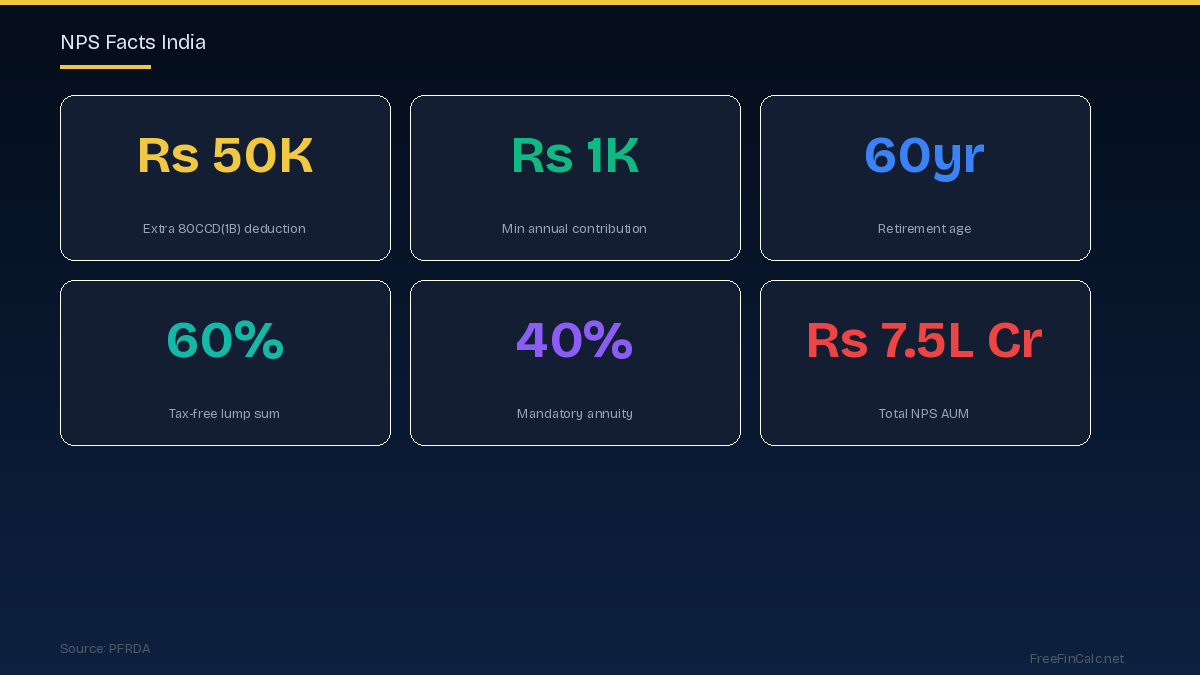
The National Pension System offers an exclusive Rs 50,000 tax deduction under Section 80CCD(1B) that is over and above the Rs 1.5 lakh 80C limit. At the 30 percent tax bracket (including cess), this saves Rs 15,600 in taxes every year. Over a 25-year career, that is Rs 3.9 lakh in tax savings alone — not counting the returns on your NPS investment. Use our retirement calculator to see how NPS fits your retirement corpus.

NPS has grown from a niche government scheme to managing over Rs 7.5 lakh crore with returns of 10 to 12 percent on the equity tier — competitive with mutual funds. The key advantage: it forces long-term retirement savings with limited withdrawal options, which prevents the premature spending that destroys most Indian retirement plans.
How to Optimize Your NPS Investment
If you are under 35, choose aggressive allocation: 75 percent equity (E), 15 percent corporate bonds (C), 10 percent government securities (G). This maximizes growth during your highest risk-tolerance years. NPS automatically reduces equity allocation as you age (auto-choice lifecycle fund), or you can manage it actively (active choice).

Choose a Pension Fund Manager (PFM) with the best track record. SBI, HDFC, and ICICI Prudential are the largest PFMs. Compare their equity tier returns over 5 and 10 year periods before selecting. You can change your PFM once per year if performance is unsatisfactory.
NPS Maturity: The 60-40 Rule
At age 60, you can withdraw 60 percent of your corpus as a tax-free lump sum. The remaining 40 percent must be used to buy an annuity (monthly pension) from an insurance company. The annuity income is taxable at your slab rate. If your total NPS corpus is Rs 1 crore, you receive Rs 60 lakh tax-free and Rs 40 lakh buys an annuity providing roughly Rs 25,000 to 30,000 per month. Use our compound interest calculator and investment calculator to project your NPS corpus at retirement.
Try These Free Calculators
Frequently Asked Questions
What is the NPS tax benefit?
NPS offers three tax benefits: Rs 1.5 lakh under Section 80C (shared with other 80C investments), extra Rs 50,000 under Section 80CCD(1B) (exclusive to NPS), and employer contribution up to 14 percent of basic under 80CCD(2). The exclusive Rs 50,000 deduction is the main attraction — at 30 percent bracket, it saves Rs 15,600 in taxes.
What returns does NPS give?
NPS returns depend on your allocation. The Equity tier (E) has returned 10 to 12 percent historically, Corporate Bond tier (C) 8 to 10 percent, and Government Securities tier (G) 7 to 8 percent. Aggressive allocation (75 percent equity for age under 35) has given 10 to 12 percent average returns.
Can I withdraw from NPS before retirement?
Partial withdrawal is allowed after 3 years for specific purposes: higher education, home purchase, medical treatment, etc. Up to 25 percent of your contributions can be withdrawn. Full exit before 60 requires 80 percent to be used for annuity purchase.
What happens at NPS maturity at 60?
You can withdraw up to 60 percent as lump sum (tax-free) and must use minimum 40 percent to buy an annuity (pension) from an insurance company. The annuity income is taxable. If total corpus is under Rs 5 lakh, you can withdraw 100 percent.
NPS vs mutual fund SIP: which is better?
NPS wins on tax benefits (extra Rs 50,000 deduction) and forced retirement savings. Mutual fund SIP wins on liquidity, fund choice, and flexibility. The ideal approach: use NPS for the Rs 50,000 tax benefit, then invest the rest in mutual fund SIPs for more flexibility and control.