SIP Calculator India 2026: How to Calculate SIP Returns and Build Wealth
Updated April 2026 · 11 min read

What Is SIP and Why Every Indian Should Start One
A Systematic Investment Plan is the simplest way to build wealth in India. You invest a fixed amount every month into a mutual fund, regardless of whether the market is up or down. When prices are high, your SIP buys fewer units. When prices are low, it buys more units. Over time, this averaging effect — called rupee cost averaging — smooths out market volatility and builds wealth consistently.
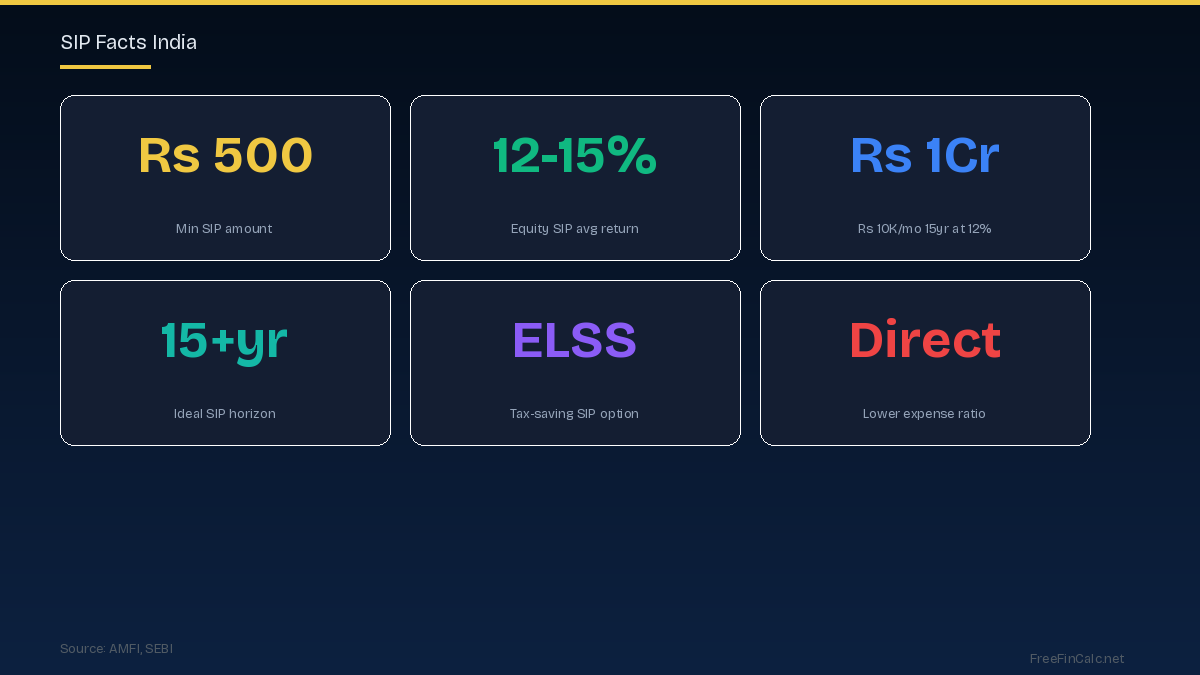
The numbers are compelling: Rs 10,000 per month invested via SIP at 12 percent average return grows to Rs 23.2 lakh in 10 years, Rs 50 lakh in 15 years, and over Rs 1 crore in 20 years. The initial investment over 20 years is only Rs 24 lakh — the remaining Rs 76 lakh comes from compounding returns. Use our compound interest calculator to model your specific SIP growth.
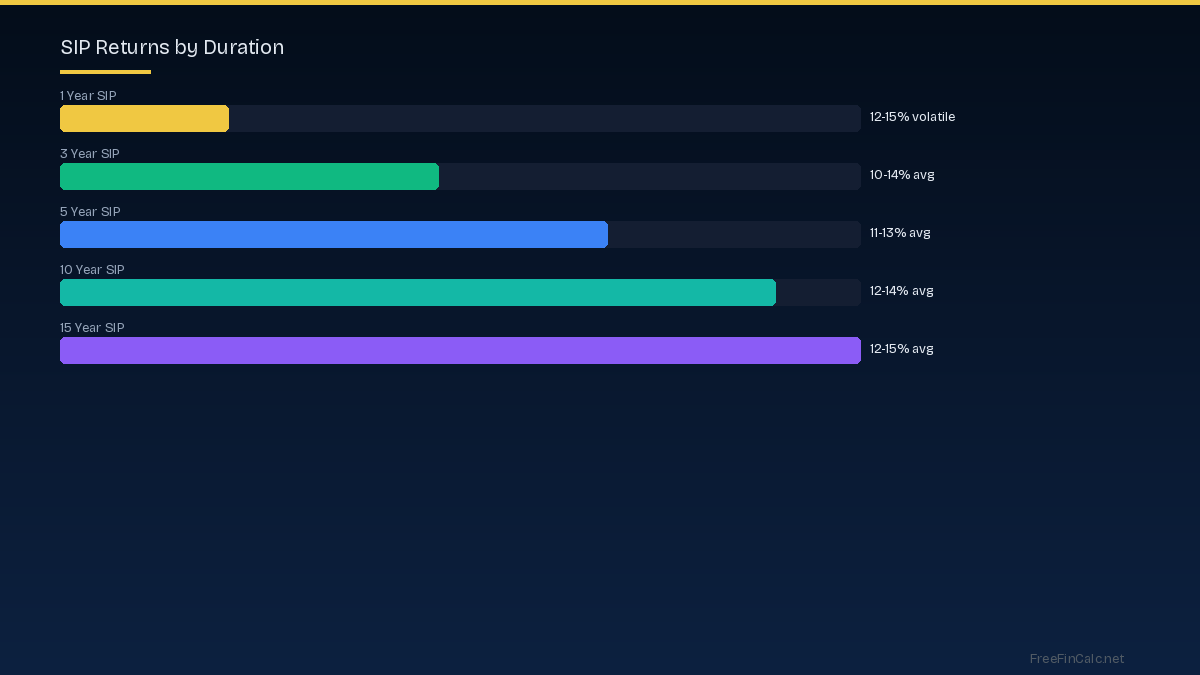
India now has over 44 million SIP accounts with monthly inflows exceeding Rs 19,000 crore. This is not a niche investment strategy — it is the primary wealth-building tool for the Indian middle class. If you are not running a SIP yet, you are leaving lakhs on the table.
How to Start Your First SIP in 10 Minutes
Step one: complete your KYC if not already done. You can do eKYC online through your mutual fund app or AMC website using Aadhaar and PAN. Takes 5 minutes. Step two: choose a fund. For beginners, a Nifty 50 index fund is the simplest and most effective choice. Step three: set your SIP amount and date. Most people choose the 1st or 5th of each month. Step four: link your bank account for auto-debit. The SIP runs automatically every month without you lifting a finger.

Always choose direct plans over regular plans. Direct plans have 0.5 to 1 percent lower expense ratios because there is no distributor commission. Over 20 years, this difference compounds to 15 to 20 percent more money in your pocket. Use platforms like Kuvera, Groww, or Coin by Zerodha for direct plan SIPs.
Step-Up SIP: The Strategy That Doubles Your Corpus
A step-up SIP increases your monthly amount by a fixed percentage every year. If you start at Rs 10,000 and increase by 10 percent annually, your SIP amount in year 5 is Rs 14,641 and in year 10 is Rs 23,579. The total corpus with step-up is dramatically higher than flat SIP: approximately Rs 35 lakh versus Rs 23 lakh after 10 years at 12 percent return. Most fund apps now support automatic step-up SIP.
SIP for Tax Saving: ELSS Funds
ELSS (Equity Linked Savings Scheme) SIPs give you Section 80C tax deduction of up to Rs 1.5 lakh per year while investing in equity. The lock-in is only 3 years per installment — the shortest among all 80C options. ELSS has historically returned 12 to 15 percent annually, making it both a tax saver and a wealth builder. Compare top ELSS funds on our investment return calculator.
When to Review (And When Not to Touch) Your SIP
Review your SIP funds once a year. If a fund consistently underperforms its benchmark for 3 or more years, switch to a better-performing fund or an index fund. Do NOT stop your SIP during market crashes — that is the worst possible timing. Crashes are when your SIP buys units at discounted prices, which drives higher returns when the market recovers. The 2020 crash rewarded SIP investors who stayed invested with 50 to 100 percent gains within 18 months. Plan your full retirement strategy with our retirement calculator.
Try These Free Calculators
Frequently Asked Questions
How much can I earn from SIP of Rs 10,000 per month?
At 12 percent average return: Rs 10,000 per month SIP for 10 years grows to Rs 23.2 lakh. For 15 years: Rs 50 lakh. For 20 years: Rs 1 crore. For 25 years: Rs 1.9 crore. The power of compounding accelerates returns dramatically in later years.
What is the minimum SIP amount?
Most mutual funds allow SIP starting from Rs 500 per month. Some funds have Rs 100 minimum. There is no maximum limit. Start with whatever you can afford and increase by 10 percent every year using step-up SIP.
Is SIP better than FD?
For goals beyond 5 years, equity SIP has historically outperformed FD significantly. SIP in equity funds returns 12 to 15 percent long-term versus 6.5 to 7.5 percent for FD. However, SIP has short-term volatility while FD returns are guaranteed.
Which SIP fund should I choose as a beginner?
Start with a Nifty 50 index fund SIP. It gives you diversified exposure to India top 50 companies at the lowest expense ratio (0.05 to 0.20 percent). UTI Nifty 50 Index Fund and HDFC Index Fund Nifty 50 are popular choices.
Can I stop SIP anytime?
Yes. SIP can be stopped or paused anytime without penalty. You can also reduce or increase the amount. There is no lock-in period for regular equity SIP. Only ELSS SIP has a 3-year lock-in per installment for tax benefit.